
Life After Dallas Drug and Alcohol Rehab: A Guide to Relapse Prevention and Aftercare
TL;DR
Addiction is a chronic condition. Treatment manages it but does not cure it, so a plan for life after rehab matters as much as the stay itself.[1]
Relapse is common and does not mean treatment failed. It is a signal to resume, change, or add treatment.[1]
Write a relapse prevention plan before you leave: triggers, warning signs, people to call, and what you will do in the first hour of a craving.
Layer your aftercare: outpatient care, therapy, support groups, and, if you need it, sober living.
After a stretch of abstinence, tolerance drops. Using the same amount as before can cause an overdose.[1]
Table of Contents
Why the transition out of Dallas drug and alcohol rehab is a risky time
Understanding relapse: warning signs, triggers, and common myths
Aftercare options in Dallas: outpatient care, therapy, sober living, and support groups
Rebuilding daily life: routines, work, relationships, and mental health
Introduction
The day you finish treatment can feel strange. For weeks, your meals, sleep, and hours were arranged for you. Then you walk back into the same apartment, the same traffic on I-35, the same phone with the same contacts in it.
This guide is for people finishing dallas drug and alcohol rehab and for the families beside them. It covers what relapse is, how to build a plan, what aftercare exists in Dallas, and what to do if things slip. Our team at Dallas Detox Center wrote it so you have straight answers and a next step.
Why the transition out of Dallas drug and alcohol rehab is a risky time
The National Institute on Drug Abuse (NIDA) describes addiction treatment the way doctors describe care for heart disease or asthma. It is not a cure. It is a way of managing a condition.[1] Management does not end at discharge.
Leaving a structured setting removes the walls that protected you. Cravings that were quiet in treatment can return when you are tired, stressed, or alone. That is normal, and it is the reason a plan matters.
The same NIDA material shows that the brain can recover, at least in part, after a long period without drugs. Its example is brain imaging of dopamine transporters in people who stopped using methamphetamine.[1] Healing takes time, and the early months are when you are most exposed.

Understanding relapse: warning signs, triggers, and common myths
Relapse rarely starts with a drink or a pill. It usually starts days or weeks earlier, with changes in thinking and behavior.
Early warning signs
Skipping meetings, therapy, or check-ins with a reason that sounds reasonable.
Sleeping badly, or barely eating.
Pulling away from people who know your story.
Romanticizing past use ("it wasn't that bad").
Contacting old friends who still use, or driving past old spots.
Irritability, resentment, or a sense that nothing is working.
Common triggers
Trigger type | Examples | A practical response |
|---|---|---|
People | Old drinking or using friends, certain relatives | Decide in advance who you will not see alone |
Places | Bars, a dealer's neighborhood, a parking lot | Change your route home |
Emotions | Anger, loneliness, shame, boredom | Call someone before you act, not after |
Physical states | Pain, poor sleep, hunger | Treat the body early and tell your doctor about pain |
Celebrations | Holidays, weddings, a promotion | Bring your own drink and an exit plan |
Myths that cause harm
Myth: relapse means treatment failed. NIDA says no. Relapse rates for substance use disorders are similar to those for other chronic illnesses such as high blood pressure and asthma, and a relapse signals that treatment should be resumed, modified, or changed.[1]
Myth: a relapse is harmless if you "only slip once." It can be dangerous. If you use as much as you did before quitting, your body may no longer tolerate it, and you can overdose.[1] If opioids are part of your history, keep naloxone at home. Our article on Narcan myths and facts explains how it works.

Building a personal relapse prevention plan
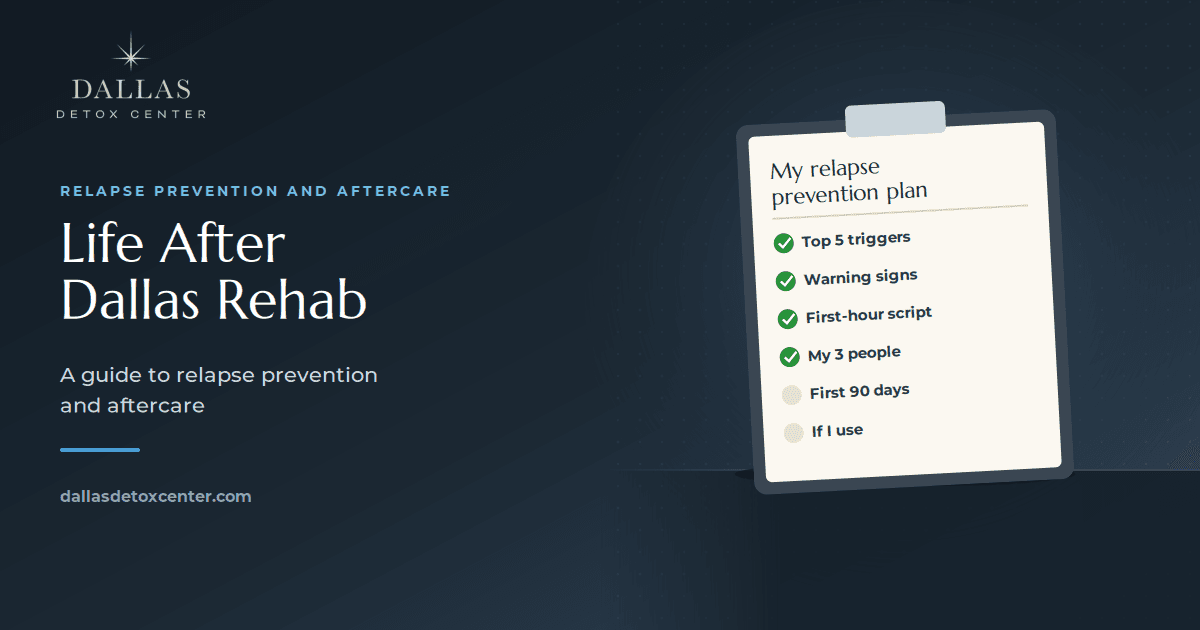
A good plan is written down, short enough to use when you are upset, and shared with at least one other person. Work on it with your counselor before discharge. Our aftercare planning is built around this step.
List your top five triggers in your own words, not clinical ones.
List your personal warning signs. Ask family what they noticed before.
Write a first-hour script. When a craving hits: leave the situation, call a named person, wait 20 minutes, eat something, go to a meeting.
Name three phone numbers and save them as favorites.
Set your schedule for the first 90 days: appointments, meetings, work, sleep.
Decide what you will do if you use. Who you will call, and which program you will contact the same day.
If you ever feel in danger of harming yourself, call or text 988, the Suicide & Crisis Lifeline listed by SAMHSA.[2]

Aftercare options in Dallas: outpatient care, therapy, sober living, and support groups
Most people do best with more than one layer. The American Society of Addiction Medicine (ASAM) publishes the ASAM Criteria, guidelines for matching a person-centered treatment plan to the person, including those with co-occurring conditions.[3] That is why your aftercare should look different from someone else's.
Option | What it is | Often a fit when |
|---|---|---|
Intensive outpatient | Several sessions a week while you live at home | You have stable housing and a supportive home |
Standard outpatient and therapy | Weekly individual or group counseling | You are stable and need ongoing skills work |
Sober living | Shared housing with house rules and peers in recovery | Home is full of triggers or use |
Support groups | Peer meetings such as 12-step or other mutual-aid groups | Nearly everyone, for free and ongoing support |
Medical follow-up | A doctor who monitors medication and health | You take medication for addiction or a mental health condition |
If you work full time, read our piece on outpatient and evening programs. If anxiety, depression, or trauma sits underneath your use, dual diagnosis care treats both together. You can also search for local providers at FindTreatment.gov through SAMHSA.[2]

Rebuilding daily life: routines, work, relationships, and mental health
Recovery fills a hole. If you remove drinking or using and put nothing in its place, the hours get loud. Start with the basics: a fixed wake time, regular meals, movement, and a hard bedtime.
At work, decide what you will tell people. You do not owe anyone your history. A short line works: "I had a health issue and I'm handling it." If a job is tied to your use, such as a bar or a high-pressure sales floor, talk with your counselor about changing it, not just coping with it.
Relationships need repair, and repair is slow. Apologies count less than months of showing up. Keep up mental health care too. Untreated depression and anxiety are common relapse drivers, so keep your therapy and any prescribed medication going even when you feel fine.

How family and loved ones can support recovery
Families often swing between watching every move and giving up. Neither helps. Support means being steady and clear about your limits.
Do: ask how you can help, attend a family session if offered, keep alcohol out of the house if your loved one asks, and learn the warning signs above.
Do: tell the truth calmly if you see changes. "I've noticed you stopped going to meetings and I'm worried" is enough.
Don't: pay off debts caused by use, cover for missed work, or lie to others on their behalf. That is enabling.
Don't: treat one slip as proof that it was all for nothing.
Look after yourself as well. Family support groups and your own counselor are not extras.
What to do if a relapse happens
Act the same day. Shame says to hide it. Do the opposite and tell someone on your list.
Stop and stay safe. If you used opioids, do not use alone, and have naloxone nearby. Call 911 for an overdose.
Call your counselor or doctor. NIDA says a relapse means you should speak with your doctor to resume treatment, change it, or try another approach.[1]
Get medical help if you used heavily. Stopping suddenly after alcohol or benzodiazepines can be dangerous. See our alcohol detox and benzo detox programs.
Look at what happened. Which trigger, which warning sign did you miss, and what in the plan needs to change?
Step care back up. That may mean more outpatient sessions or a return to residential care.
Frequently Asked Questions
Q: What is aftercare, and why is it important after leaving rehab?
A: Aftercare is the ongoing support you use once residential or intensive treatment ends: counseling, support groups, medical follow-up, and sometimes sober housing. It matters because addiction is managed over time, not cured, much like other chronic illnesses.[1]
Q: How common is relapse after drug and alcohol treatment, and does it mean treatment failed?
A: Relapse is common, and NIDA reports rates similar to those for high blood pressure and asthma. It does not mean treatment failed. It means treatment needs to be resumed, adjusted, or changed.[1]
Q: What are the early warning signs of relapse I should watch for?
A: Missed meetings, poor sleep, isolation, irritability, glamorizing past use, and contact with people who still use. They tend to show up before any substance does, so tell your support person when you notice them.
Q: What aftercare options are available in the Dallas area once I finish rehab?
A: Intensive and standard outpatient programs, individual and group therapy, sober living homes, peer support groups, and medical follow-up. SAMHSA's FindTreatment.gov can help you search locally.[2] Dallas Detox Center can also build a plan with you through aftercare planning.
Q: How can family members support a loved one after rehab without enabling them?
A: Offer time, rides to appointments, and honest conversation. Do not give money for crises caused by use, cover for missed obligations, or hide the problem from others. Set limits and keep them calmly.
Conclusion
Finishing dallas drug and alcohol rehab is the start of the long part. A written plan, layered aftercare, steady routines, and a family that knows the difference between support and enabling all lower the odds of a slip, and a fast response limits the damage if one comes.
If you are leaving treatment, or you slipped and need to start again, Dallas Detox Center can help. Review our treatment services or visit dallasdetoxcenter.com to talk with our team today. If cost is a worry, see how to verify your insurance benefits first.
References
National Institute on Drug Abuse. Treatment and Recovery, Drugs, Brains, and Behavior: The Science of Addiction. https://nida.nih.gov/publications/drugs-brains-behavior-science-addiction/treatment-recovery
Substance Abuse and Mental Health Services Administration. Recovery and Support. https://www.samhsa.gov/find-help/recovery
American Society of Addiction Medicine. ASAM - American Society of Addiction Medicine. https://www.asam.org