
What to Expect Your First 72 Hours in Drug Rehab in Dallas: A Day-by-Day Admission and Detox Walkthrough
TL;DR
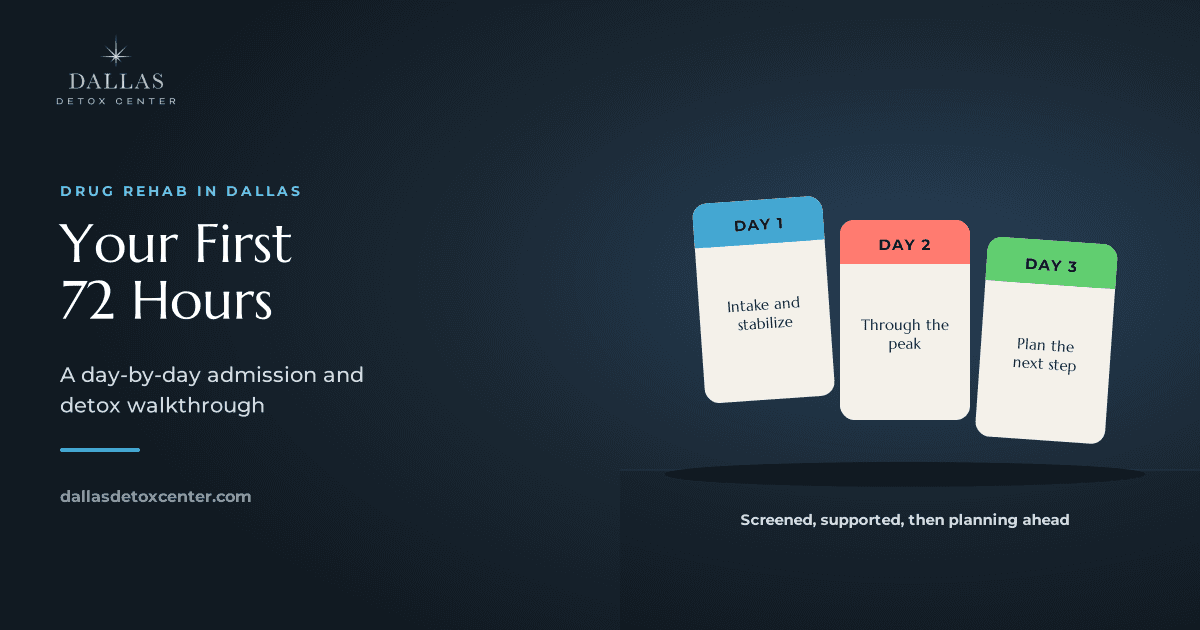
The first 72 hours of drug rehab in Dallas are about safety: a medical screening, a full assessment, and supervised detox with medication when it is needed.
Withdrawal usually feels worst on day 2 for many substances, but timelines differ a lot between alcohol, opioids, benzodiazepines, and stimulants.
Detox is not the whole treatment. By day 3, your team should be helping you choose a next level of care.
Family can help most by packing well, staying calm, and respecting a limited contact window early on.
Table of Contents
Before you arrive: preparing for admission at a drug rehab in Dallas
Hour 0 to 12: intake, medical screening, and initial assessment
Day 1: starting medically supervised detox and symptom management
Day 2: withdrawal peaks, comfort care, and emotional support
How withdrawal differs by substance: alcohol, opioids, benzodiazepines, and stimulants
Introduction
Most people do not fear rehab itself. They fear the first three days: the unknown room, the withdrawal, the loss of control. If that is you, or you are the one helping someone you love get there, you deserve a straight account of what happens.
This walkthrough covers the first 72 hours of drug rehab in Dallas hour by hour, based on how medically supervised detox generally works and how we run it at Dallas Detox Center. Individual care varies, and your own medical team makes the final calls. But these three days are more predictable than you might think.

Before you arrive: preparing for admission at a drug rehab in Dallas
Most of the work before admission is a phone call. A staff member asks what you have been using, how much, how often, and when you last used. Be honest. Nobody on the line is judging you, and the answers decide whether you need medical detox first. If you want to confirm coverage before you go, our post on how insurance covers drug and alcohol rehab in Dallas explains how to verify benefits.
Tell the admissions team about every medication you take, any health conditions, and any history of seizures. Do not stop alcohol or benzodiazepines on your own the night before. Those two withdrawals can be dangerous without medical oversight.
Pack for a stay of several days to a few weeks:
Comfortable, loose clothing and slip-on shoes
Photo ID and your insurance card
A list of current medications and doses, plus your pharmacy and doctor contacts
Basic toiletries without alcohol (many mouthwashes and sprays contain it)
A few phone numbers written on paper, since phone access may be limited
Leave behind drugs and alcohol (obviously), weapons, large amounts of cash, valuables, and anything you would hate to lose. Facilities check bags at the door.

Hour 0 to 12: intake, medical screening, and initial assessment
You will sign consent forms, hand over your belongings for inventory, and meet a nurse. Expect a lot of questions. It can feel repetitive, but each person who asks is looking at something different.
The medical screening usually includes vital signs, a physical exam, and often a urine drug screen and blood work. The team is checking how your body is doing right now and how severe withdrawal could get. A clinician also screens for depression, anxiety, trauma, and thoughts of self-harm, because substance use and mental health problems often occur together. If that sounds like you, ask about dual diagnosis care.
The assessment follows a structured framework. The ASAM Criteria, a standard used across addiction medicine, lays out how to assess a person's medical, psychological, and social needs, build an individualized treatment plan, and match the person to the right level of care.[1] In plain terms, your plan should be built around you, not copied from the last person in the bed.
By the end of these first hours you should have a room, a first dose of any needed medication, a clear idea of who your nurse is, and a rough plan for day 1.

Day 1: starting medically supervised detox and symptom management
Day 1 is about stabilizing you. Staff check your vital signs often, sometimes every few hours, and score your withdrawal symptoms using standard scales. Those scores guide medication doses, so tell them honestly how you feel. Downplaying symptoms does not make you look strong. It makes the dosing less accurate.
Early symptoms depend on the substance. They may include anxiety, sweating, nausea, aching, trouble sleeping, or tremor. According to the National Institute on Drug Abuse, medications and behavioral therapy are both part of effective care for withdrawal.[2] Our medical detox program uses both from the start.
Eat and drink what you can. Sleep when you can. Short walks and a shower often help more than people expect.

Day 2: withdrawal peaks, comfort care, and emotional support
For many people, day 2 is the hardest. Symptoms are often at or near their peak, and your mood may be low and your patience short. That is withdrawal, not failure. Nurses check on you more often, adjust medications, and watch for anything that needs a physician.
Comfort care is concrete: medication for nausea, muscle pain, and sleep where appropriate, fluids, a quiet room, and someone who stays with you through the bad hours. Emotional support starts here too. A counselor may sit with you for a short session, not to dig into your history, but to help you get through the day.
Cravings are common on day 2. NIDA lists strong cravings and withdrawal symptoms among the recognized features of a substance use disorder.[2] Telling staff when a craving hits is useful information, not a confession.

Day 3: stabilization and planning your next level of care
By day 3, many people start to feel a shift. Sleep is a little better, appetite may return, and the sharpest symptoms ease. Some symptoms, especially sleep trouble and low mood, can linger for weeks.
This is also when planning gets real. Detox clears substances from your body. It does not treat the reasons you used or teach you how to stay well. Your team will talk with you about where to go next, using the same level-of-care thinking that guided your intake.[1]
The options generally look like this:
Level of care | What it looks like | Often fits when |
|---|---|---|
You live at the facility with daily therapy | Home is unstable or use has been heavy and long | |
Outpatient or evening programs | You live at home and attend scheduled sessions | Home is stable and you must keep working (see our post on outpatient care for working professionals) |
Live-in care focused on a co-occurring mental health condition | Depression, trauma, or anxiety is driving much of the struggle |
NIDA notes that outpatient care can include office or telehealth visits for counseling, medication support, or both.[2] Whatever you choose, you can start aftercare planning now, and our guide to life after rehab picks up where this walkthrough ends.

How withdrawal differs by substance: alcohol, opioids, benzodiazepines, and stimulants
The 72-hour frame is the same, but what happens inside it is not. These are general patterns. Your own course depends on your health, how long you used, and how much.
Substance | Typical first 72 hours | Main safety concern |
|---|---|---|
Tremor, sweating, anxiety, nausea; symptoms often build over the first day or two | Seizures and delirium tremens | |
Opioids (heroin, fentanyl, prescription pills) | Aches, vomiting, diarrhea, chills, restlessness; very uncomfortable but rarely life-threatening on its own | Dehydration, and relapse after tolerance drops |
Anxiety, insomnia, tremor; can start later and last longer, especially with long-acting drugs | Seizures; usually needs a slow, supervised taper | |
Exhaustion, heavy sleep, depressed mood, strong cravings | Severe depression and suicidal thoughts |
Two points matter most. Alcohol and benzodiazepine withdrawal can be medically dangerous, which is why they should not be stopped abruptly at home. And stimulant withdrawal looks mild on the outside but can bring a heavy emotional crash, so the mental health check matters as much as the physical one. For a related case, see our guide on quitting codeine cough syrup safely.

How family can help and what to do after the first 72 hours
Early contact is often limited. This protects the person while they are sick and gives the team space to work. Ask the admissions staff what the call and visit policy is, and ask who can be your point of contact for updates, given consent rules.
What helps most:
Keep messages short and kind. Skip old arguments for now.
Handle practical tasks: work notices, childcare, pets, bills.
Ask the team about a family session and what you can learn before discharge.
Learn how to use naloxone if opioids are involved. Our post on Narcan myths and facts covers it.
After hour 72, the real work continues. NIDA describes substance use disorders as chronic but treatable conditions from which people can recover.[2] SAMHSA offers a national helpline and FindTreatment.gov if you want to compare options.[3] If you are still deciding whether to go at all, 7 signs it is time to seek drug rehab in Dallas may help, and 10 questions to ask before choosing a Dallas drug rehab program can guide your search.
Frequently Asked Questions
Q: What should I bring to drug rehab in Dallas, and what should I leave at home?
A: Bring comfortable clothes, photo ID, your insurance card, a list of your medications, and basic toiletries without alcohol. Leave drugs, alcohol, weapons, valuables, and large amounts of cash at home. Ask your admissions contact for the facility's exact list, since rules vary.
Q: Will I be in pain or very sick during detox, and what medications might be used to keep me comfortable?
A: You will likely feel unwell, but medical detox exists to reduce that. NIDA notes that safe, effective medications are available for treating withdrawal symptoms.[2] Which medications are used depends on the substance and your health. A physician decides, and nurses adjust based on how you are feeling.
Q: Is 72 hours enough to complete detox, or will I need further treatment afterward?
A: For some substances, the worst of acute withdrawal passes in about three days. For others, such as benzodiazepines, it can take longer. Either way, detox alone does not treat addiction. Most people need continued care, and your team will recommend a level based on your assessment.[1]
Q: Can my family contact me or visit during the first 72 hours?
A: Often contact is limited early on, because you are sick and the team needs time to stabilize you. Many facilities allow brief calls or updates through a designated contact once you consent. Ask about the specific policy before admission so nobody is surprised.
Q: Does insurance cover detox and residential treatment in Texas, and how do I verify my benefits before admission?
A: Many plans cover some level of detox and residential care, but coverage varies by plan. Call the number on your insurance card or have our admissions team run a verification. SAMHSA also lists insurance-specific guidance on its treatment page.[3] Our full guide on insurance and rehab in Dallas walks through it step by step.
Conclusion
The first 72 hours of drug rehab in Dallas are hard, but they are structured, watched, and survivable. You are screened on day 1, supported through the worst of withdrawal on day 2, and planning your next step by day 3. If you are ready to ask a question or start admission, call Dallas Detox Center at dallasdetoxcenter.com and speak with someone who will tell you plainly what happens next. You can also see our full treatment services, or ask about our luxury treatment option.
References
American Society of Addiction Medicine. The ASAM Criteria. https://www.asam.org/asam-criteria
National Institute on Drug Abuse. Treatment. https://nida.nih.gov/publications/drugfacts/treatment-approaches-drug-addiction
Substance Abuse and Mental Health Services Administration. Substance Use Disorder Treatment. https://www.samhsa.gov/substance-use/treatment