
Inpatient vs. Outpatient Drug Rehab Dallas TX: Which Level of Care Matches Your Situation?
TL;DR
Inpatient rehab means you live at the facility with 24-hour support. Outpatient means you live at home and attend treatment on a schedule.
Clinicians match people to a level of care using the ASAM Criteria, which weighs six areas of your life, not just which drug you use.[1]
Withdrawal risk, mental health, and whether home is safe for recovery usually decide the question more than convenience does.
Most people do not stay at one level. Treatment often steps down from detox to inpatient to outpatient and aftercare.
The right answer comes from an assessment, not a guess. Dallas Detox Center can do one with you.
Table of Contents
How drug rehab in Dallas, TX is structured: understanding levels of care
What inpatient rehab involves: daily structure, medical support, and who benefits most
What outpatient rehab involves: flexibility, intensity options, and ideal candidates
Stepping down: how treatment can move from detox to inpatient to outpatient and aftercare
How to get assessed and take the first step with Dallas Detox Center
Introduction
You have probably already searched for drug rehab Dallas TX and found two words over and over: inpatient and outpatient. Nobody explains which one you need. That gap is where people stall, and stalling is costly.
This article is about the choice itself. We explain how the two levels differ, what clinicians look at when they recommend one, and how people move between them. If you want a day-by-day look at admission, read our first 72 hours walkthrough. If you are weighing evening schedules for work, our piece on Dallas drug rehab for working professionals goes further on that.
How drug rehab in Dallas, TX is structured: understanding levels of care
Treatment is not one thing. The American Society of Addiction Medicine (ASAM) publishes the standards most programs use to decide who goes where. ASAM describes its Criteria as a standardized way to connect people with substance use disorder to services based on their individual needs and circumstances.[2]
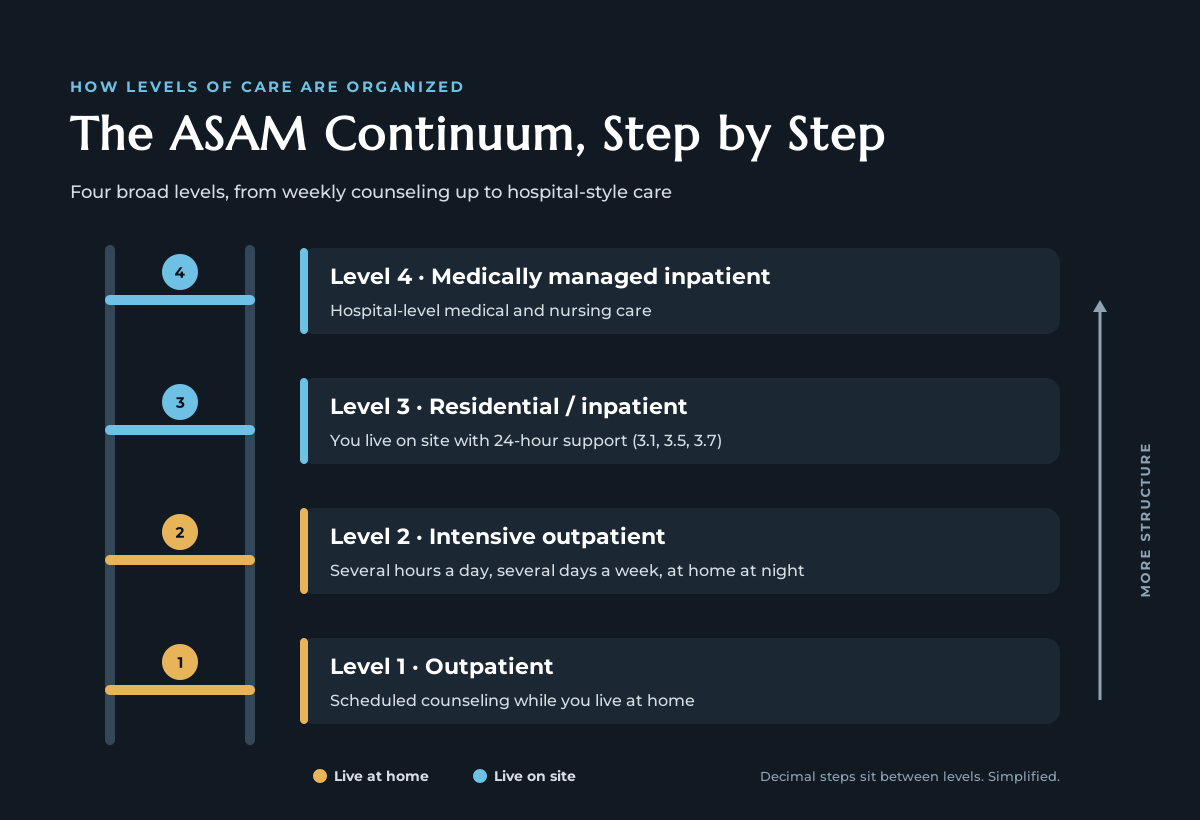
The Fourth Edition uses four broad levels with decimal steps between them, and six dimensions of assessment. Dimensions 1 through 5 produce the placement recommendation.[1] In plain terms, the levels run from weekly counseling at the light end to medically managed hospital-style care at the heavy end.
One caution. ASAM says it is not a regulator. It is a tool that clinicians and payers use, and states and insurers decide how to apply it.[1] That is why two programs can use the same words differently. Ask any program which level it actually delivers. ASAM also runs a Level of Care Certification, done with CARF International, that independently checks whether a program can deliver a given level. It currently covers adult residential programs at levels 3.1, 3.5, and 3.7.[3]
Our treatment services cover detox, residential care, dual diagnosis care, and aftercare, so the level can change as you do.
What inpatient rehab involves: daily structure, medical support, and who benefits most
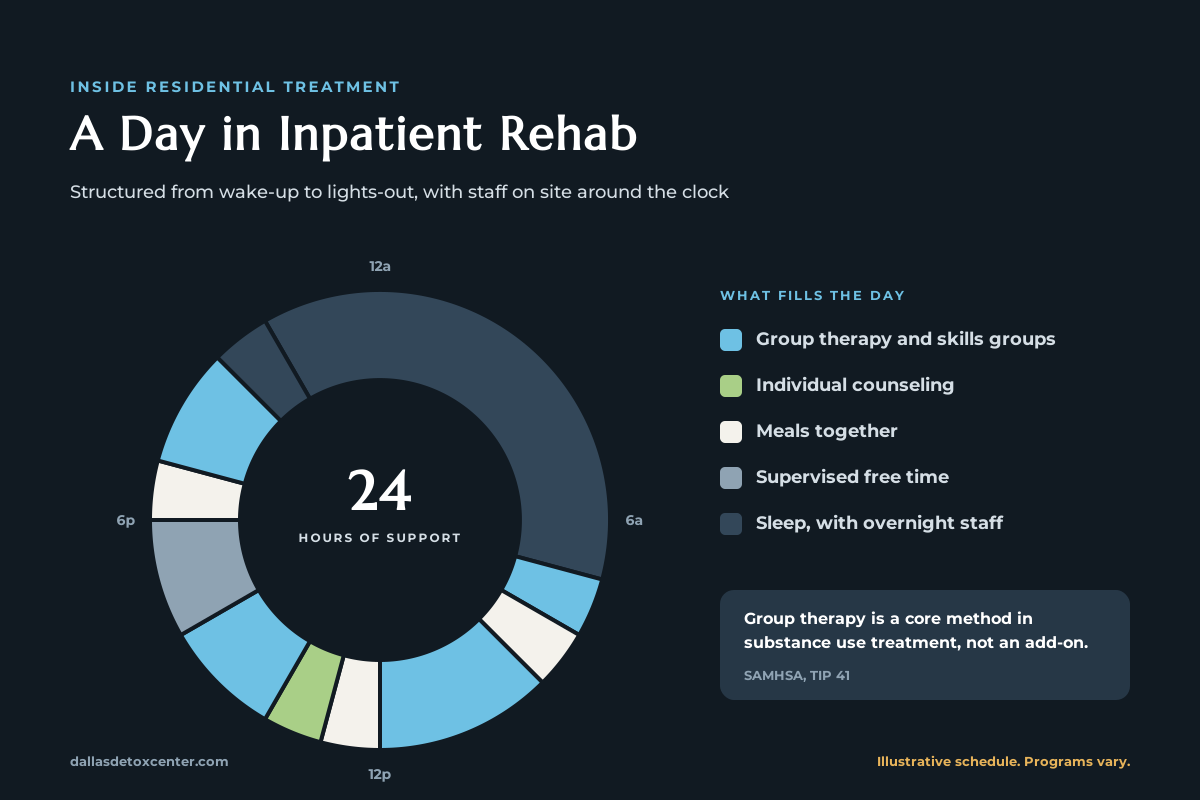
In residential inpatient treatment, you sleep at the facility. Days are full: group therapy, individual counseling, meals, medical checks, and free time that is still supervised. You are away from the people, places, and routines tied to your use.
Group therapy is a core piece of this. SAMHSA's guidance on group therapy treats it as a central method in substance use treatment, not an add-on.[4]
Inpatient care tends to fit people who:
Face dangerous withdrawal, such as from alcohol or benzodiazepines.
Have tried outpatient care and returned to use.
Live where drugs or alcohol are easy to reach, or with people who use.
Have a mental health condition that needs daily monitoring.
What outpatient rehab involves: flexibility, intensity options, and ideal candidates
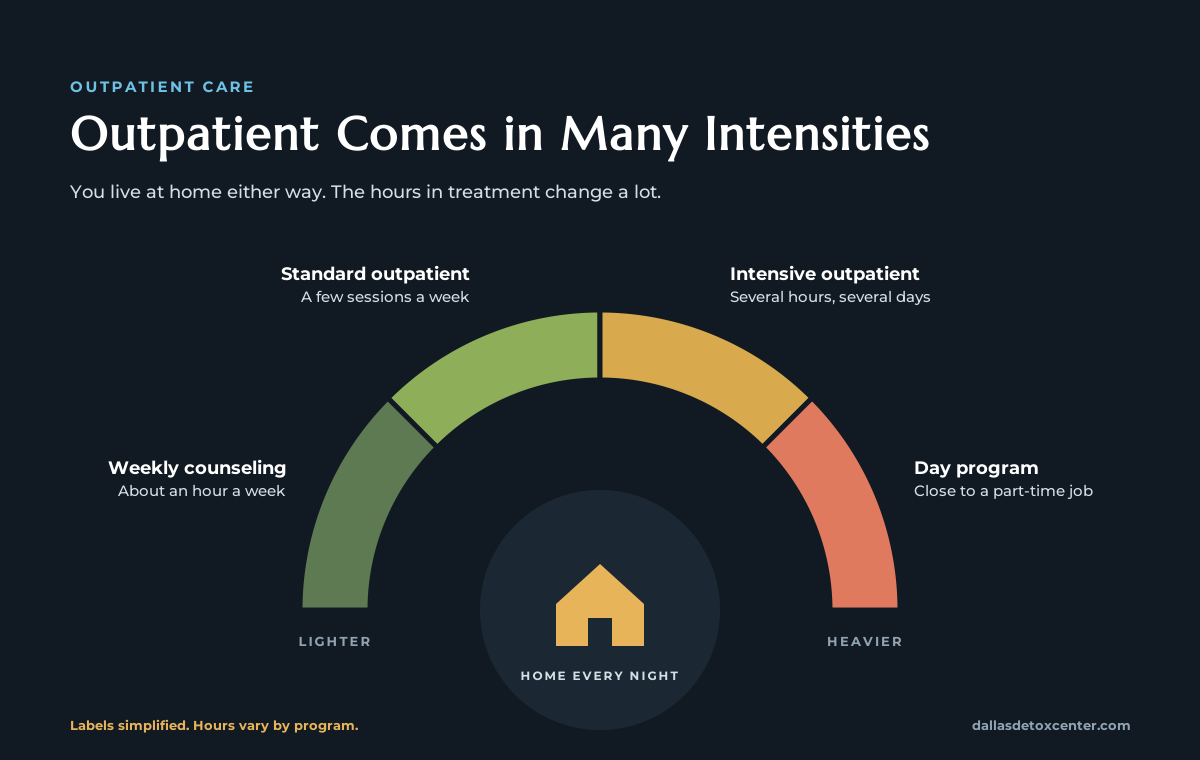
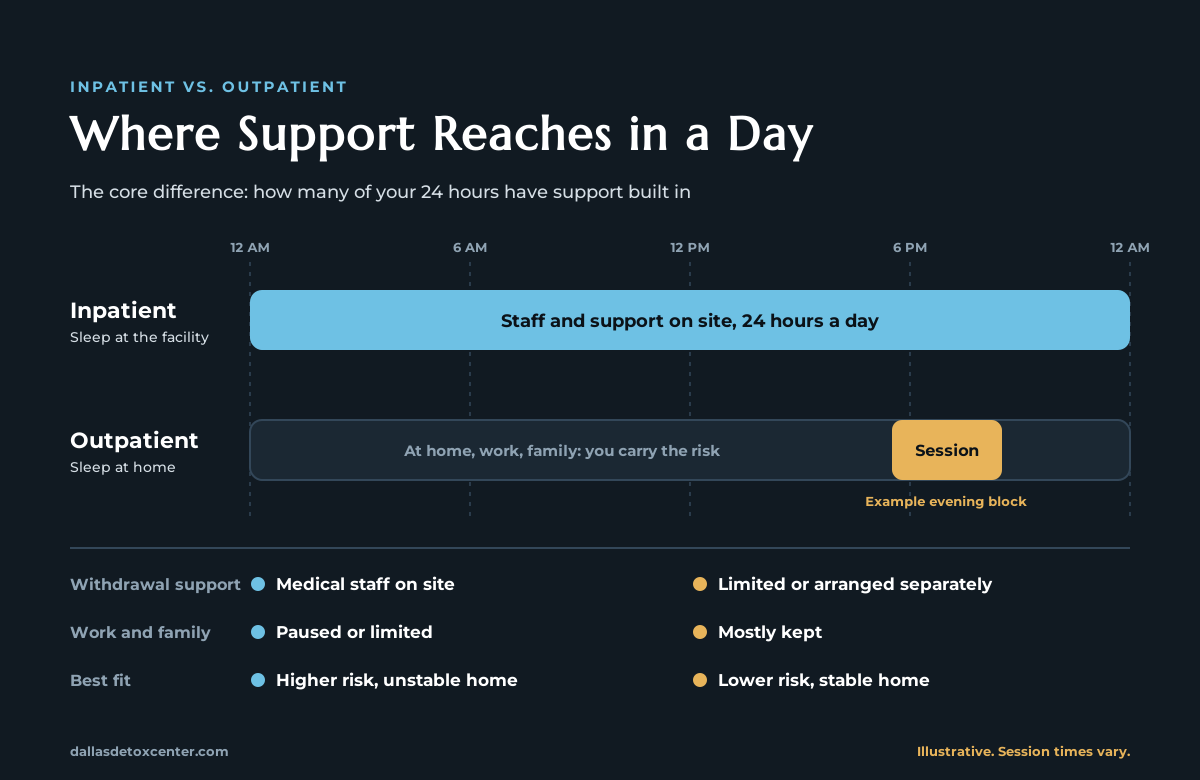
Outpatient means you live at home. The intensity varies a lot. At one end is an hour of counseling a week. At the other is a program of several hours a day, several days a week, which is close to a part-time job.
It suits people with a stable, substance-free home, a reliable way to get to sessions, and a milder or well-controlled problem. It also works well as the next step after inpatient care. The tradeoff is plain: you carry more of the risk yourself, because you go home every night to the same triggers.
Feature | Inpatient | Outpatient |
|---|---|---|
Where you sleep | At the facility | At home |
Supervision | 24 hours a day | During sessions only |
Withdrawal support | Medical staff on site | Limited, or arranged separately |
Work and family | Paused or limited | Mostly kept |
Best fit | Higher risk, unstable home | Lower risk, stable home |
Factors that determine your level of care: severity, withdrawal risk, mental health, and home environment
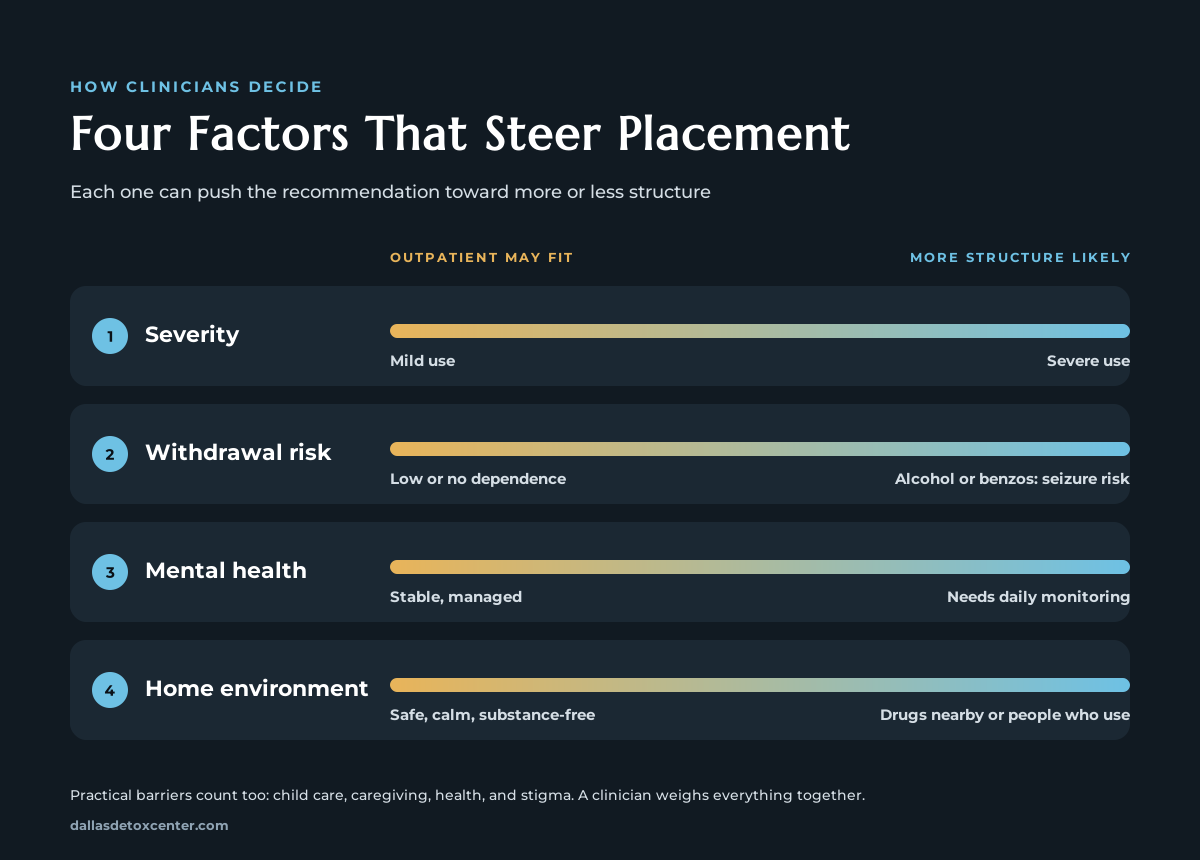
Clinicians do not pick a level by gut feeling. ASAM says its standards exist to assess medical, psychological, and social needs, build an individual plan, and match patients to the right level, and that doing so can reduce under- or over-treatment.[2] Four things carry the most weight for most people.
Severity. Alcohol use disorder can be mild, moderate, or severe.[5] Severe use points toward more structure.
Withdrawal risk. This is the one that can be life-threatening. Alcohol and benzodiazepine withdrawal can cause seizures, so those need medical oversight. See our alcohol detox and benzo detox programs for how that works.
Mental health. Depression, PTSD, and ADHD are all linked with alcohol use disorder.[5] Untreated, they pull people back to use. Dual diagnosis care treats both together.
Home environment. Ask yourself honestly: is there a safe, calm place to come home to? Barriers can also be practical. SAMHSA notes that caregiving duties, health conditions, and stigma often interfere with starting and staying in treatment, particularly for women.[6] Child care is a real factor in placement, not an excuse.
Comparing costs, insurance coverage, and time commitment
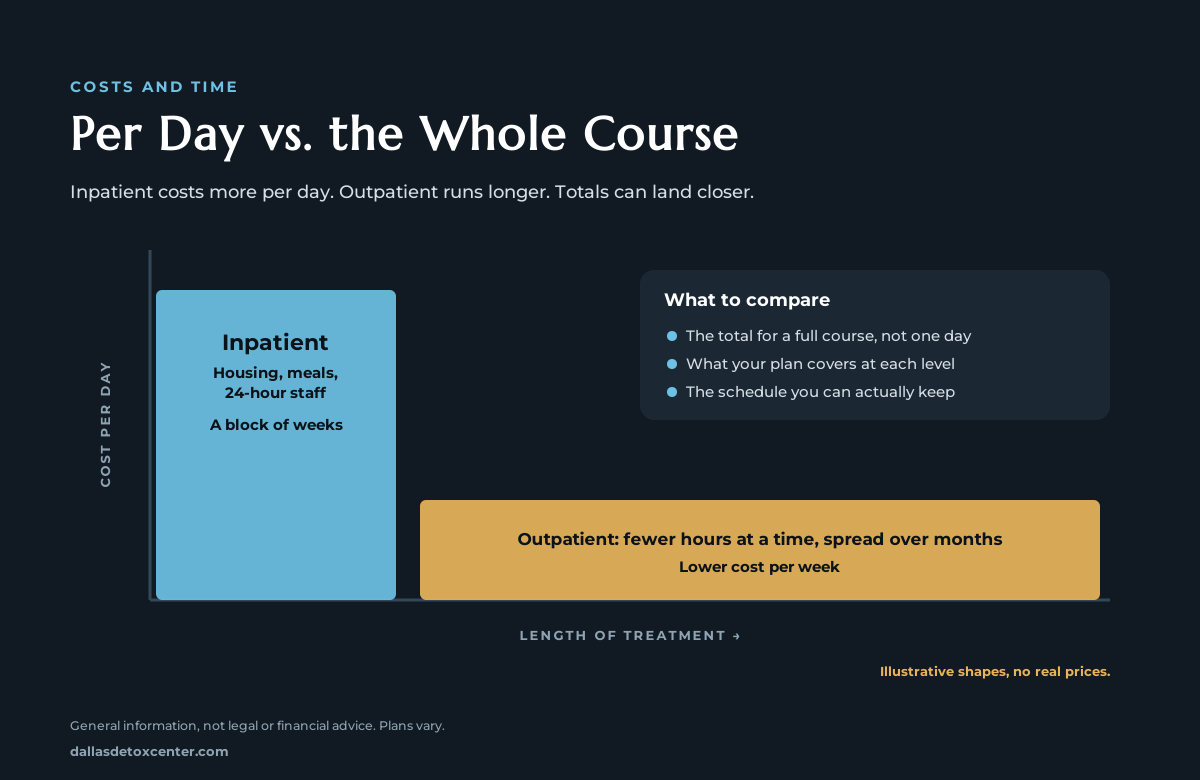
Inpatient costs more per day because it includes housing, meals, and round-the-clock staff. Outpatient costs less per week but can run for months. Over a full course, the totals can land closer than people expect. We do not quote prices here because they depend on the program and your plan.
Coverage varies by plan, and many plans cover both levels. Our guide on how to verify insurance for rehab in Dallas walks through the steps. SAMHSA also lists help for people with private insurance, Medicaid, or no insurance.[7]
On time, inpatient programs are a block of weeks away from daily life. Outpatient is fewer hours at a time but spread over a longer stretch. Choose the commitment you can actually keep up.
Stepping down: how treatment can move from detox to inpatient to outpatient and aftercare
Many people do not choose between inpatient and outpatient. They use both, in order. A common path starts with medical detox, moves to residential care, then to a lighter outpatient schedule, then to aftercare planning.
Stepping down works because risk drops over time and support can drop with it. ASAM's framework covers continued service and transfer, not only first placement.[1] If a step down goes badly, stepping back up is not failure. It is the plan working. For what comes after, see our guide to relapse prevention and aftercare.
Detox is also substance-specific. We have programs for fentanyl, heroin, meth, cocaine, and prescription drugs.
How to get assessed and take the first step with Dallas Detox Center
The first step is a conversation, not a commitment. An assessment looks at your use, your health, your mood, and your home, then recommends a level. You do not need to know the answer before you call.
If you are in crisis and not sure where to turn, SAMHSA's National Helpline gives free, confidential referrals at any hour.[8] If you want to compare our approach to others, our 10 questions to ask before choosing a program can help. If you are still unsure it is time, read 7 signs it is time to seek help.
Research on outcomes is also still being gathered. Registered studies of treatment approaches are listed publicly at ClinicalTrials.gov.[9]
Frequently Asked Questions
Q: What is the main difference between inpatient and outpatient drug rehab in Dallas, TX?
A: Where you live during treatment. Inpatient means staying at the facility with round-the-clock support. Outpatient means living at home and attending scheduled sessions. Inpatient gives more structure and medical oversight, and outpatient gives more freedom and more personal responsibility.
Q: How do I know whether I need inpatient or outpatient treatment?
A: A clinical assessment decides it. Clinicians look at withdrawal risk, physical health, mental health, readiness to change, relapse history, and your home setting. The ASAM Criteria is the standard framework for this.[1] If withdrawal could be dangerous or home is not safe, inpatient is usually advised.
Q: Is medical detox required before starting inpatient or outpatient rehab?
A: Not always, but often. If your body is physically dependent, detox usually comes first, and for alcohol or benzodiazepines it should be medically supervised. Someone with no dependence may not need it. The assessment sorts this out.
Q: Does insurance cover inpatient and outpatient drug rehab in Texas?
A: Many plans cover both, but benefits, limits, and approvals differ by plan. Call the number on your card or have our team verify benefits for you. SAMHSA also lists options for Medicaid, Medicare, and people without insurance.[7]
Q: Can I keep working or caring for my family while in outpatient rehab?
A: Often yes, especially with lower-intensity or evening programs. Higher-intensity outpatient takes several hours a day and may not fit a full schedule. Tell your care team about work and family duties up front so the schedule can be built around them.
Conclusion
Choosing drug rehab Dallas TX comes down to risk and support: how dangerous withdrawal could be, what else is going on with your health, and whether home helps or hurts. Inpatient gives the most protection. Outpatient gives the most freedom. Most people use both over time.
You do not have to settle this alone. Contact Dallas Detox Center at dallasdetoxcenter.com for an assessment, and we will tell you plainly which level fits and what the first week looks like.
References
American Society of Addiction Medicine. The ASAM Criteria and Level-of-Care Assessment: A Practical Guide. - https://careers.asam.org/career-resources/on-the-job-3/the-asam-criteria-and-level-of-care-assessment-a-practical-guide-for-addiction-medicine-professionals-113
American Society of Addiction Medicine. The ASAM Criteria. - https://www.asam.org/asam-criteria
American Society of Addiction Medicine. ASAM Level of Care Certification. - https://www.asam.org/asam-criteria/level-of-care-certification
Center for Substance Abuse Treatment. (2005, rev. 2015). Substance Abuse Treatment: Group Therapy, TIP 41. SAMHSA. - https://library.samhsa.gov/sites/default/files/sma15-3991.pdf
National Institute on Alcohol Abuse and Alcoholism. Understanding Alcohol Use Disorder. - https://www.niaaa.nih.gov/alcohols-effects-health/alcohol-use-disorder
SAMHSA. (2009). Treatment Engagement, Placement, and Planning, in Substance Abuse Treatment: Addressing the Specific Needs of Women, TIP 51. NCBI Bookshelf. - https://www.ncbi.nlm.nih.gov/sites/books/NBK83238/
SAMHSA. Substance Use Disorder Treatment. - https://www.samhsa.gov/substance-use/treatment
SAMHSA. National Helpline for Mental Health, Drug, Alcohol Issues. - https://www.samhsa.gov/find-help/national-helpline
ClinicalTrials.gov. Study NCT01381133. - https://clinicaltrials.gov/study/NCT01381133